
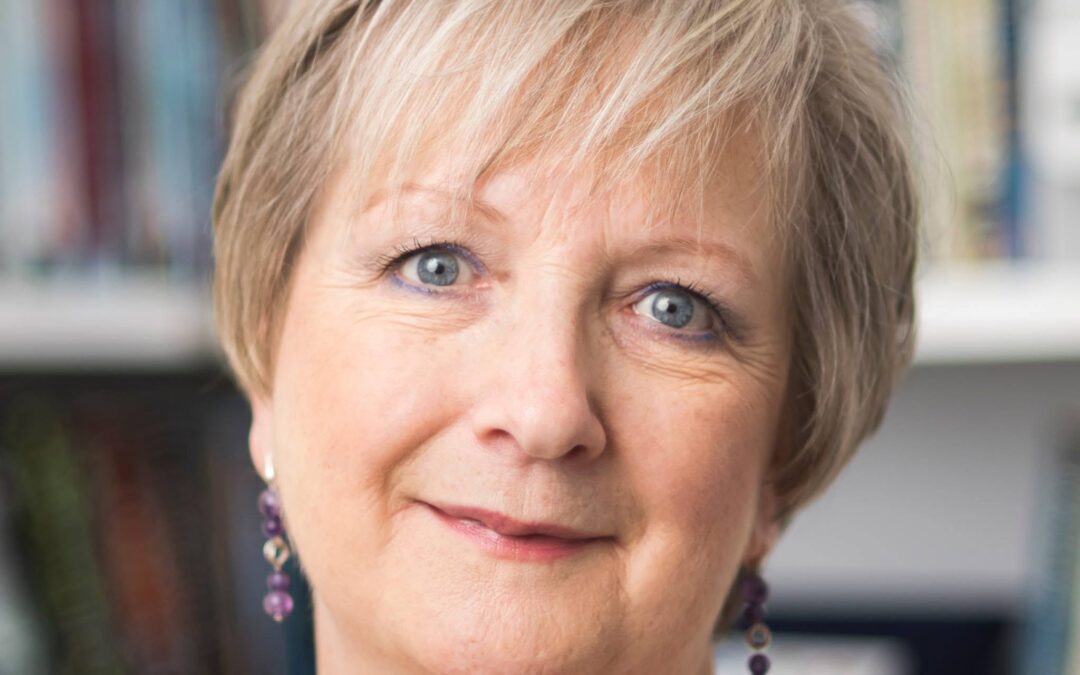
Catherine Dunne – photo by Noel Hillis
For more than three decades, Dublin writer Catherine Dunne has explored women’s lives, family bonds, motherhood, emigration and the silences that run through Irish society. Over the years, she has developed a particularly close relationship with Italian readers, who have embraced the differences between her novels without expecting the same book each time.
In this interview, she reflects on the power of fiction, the social and emotional history of women in Ireland, the control exercised by the Catholic Church and other institutions, the Mother and Baby Homes, emigration and the responsibility to preserve stories that risk being forgotten.
Her words address memory and silence, but also the ability of stories to change the way we look at the past and understand the present.
We have chosen to publish her answers in full because preserving their breadth and depth seemed the most appropriate way to honour their value.
Catherine Dunne would also like to offer special thanks to Guanda, the publisher whose faith in her work has made possible the rich and enduring relationship she has built with Italian readers.
“Stories change opinions, they challenge sacred cows, they engender empathy and thereby can have the power to change lives.”
1. For readers who love Ireland from the outside, what can fiction reveal about the country that travel, images or historical facts alone cannot show?
Ireland has changed a great deal in my lifetime. In particular, the pace of transformation during the past thirty years has been nothing short of dizzying.
One of the most significant changes is that Ireland’s geographical location on the extreme west of Europe no longer isolates us: we are part of the global village, subject to the same influences as other societies.
I think what fiction offers is a space for reflection. Modern life is full of noise: noise created by social media, by political turmoil, by economic crises. Fiction has the power to delve under all of these surfaces and explore the nuance that lies beneath.
A writer I admire greatly, Hilary Mantel, observed that if you want to know what happened to ordinary lives during a crisis, read history. (Although history is written by the winners, so we need to be careful of recorded facts, too!) But if you want to know how it felt to live through a particular time, read a novel.
I’d like to mention some recently published novels that reflect the transformation of attitudes in Irish society, and the ways in which women’s lived experience has changed. Above all, they are symbolic of the breaking down of so many walls of silence in Irish society. The lens through which society is observed in these works is motherhood – something that has been a writerly obsession of mine for many years, given the silence that often surrounds this role, not to mention the invisibility of the sheer hard work that accompanies it.
Most of the works I will mention, but not all, have been written by women. Roddy Doyle’s trilogy of novels about the fictional character Paula Spencer explores the life of a working-class mother, struggling with the effects of domestic violence, poverty, addiction. The most recent of these, The Women Behind the Door [1], portrays Paula with energy and resilience, capturing both her strength – and that of her daughter – along with her vulnerability, and does so in prose that is suffused with humour and with empathy.
Lia Mills’ powerful and beautifully written novel, Another Alice (Arlen House, Classic Literature, reissued in 2022, orig. 1996), deals with one woman’s struggle to protect her daughter, Holly, and to become a more integrated person, no longer denying the abuse of her own childhood.
‘What’s important to Alice as Holly’s mother,’ the author says, ‘is that she becomes a better, stronger mother. She learns to recognise the ways in which she was shut down when she was a child. She sees the patterns in her own reactions to Holly when she does things she regrets and slowly learns to correct those urges to protect herself at her daughter’s expense.’
Coercive control is a criminal offence in Ireland since 2018. It is defined as: ‘a persistent pattern of controlling, coercive and threatening behaviour including all or some forms of domestic abuse (emotional, physical, financial, sexual including threats) by a partner or ex-partner.
It traps victims in a relationship and makes it impossible or dangerous to leave’.
In her 2023 novel, Nesting [2], Irish writer Roisin O’Donnell writes compellingly about a young mother, Ciara Fay, pregnant with her third child, who tries to escape her manipulative and controlling husband. She flees their home with her two small children and quickly discovers how her already precarious situation is made even more precarious by Dublin’s housing crisis. She’s eventually allocated one hotel room, on a temporary basis, for herself and her children. It is a searing portrayal of the dangers and difficulties of escaping coercive control, and also a damning portrait of the failure of successive Irish governments to solve the country’s housing crisis. At the time of writing, homelessness has reached the all-time high of 17,885 people, including 5,830 children.
The novel explores the lengths to which this young mother goes to protect her children. It also celebrates her rediscovered resilience. ‘We’re not targeted for our weaknesses,’ Ciara is told at a women’s shelter. ‘We’re targeted for our strengths.’
‘Mothers are not supposed to go on road trips.
‘Mothers can go on holidays, city breaks, outings, but not on road trips. It is women without children who go on road trips. When a Mother leaves home, she is expected to return, sooner or later, with shopping bags.’ [3]
So opens the 2023 novel Breakdown by Cathy Sweeney.
The novel is a compelling narrative about a woman who walks out on her apparently perfect suburban life, complete with husband and two grown-up children.
In many ways, it is reminiscent of Anne Tyler’s The Ladder of Years, which I first read in 1995. But Sweeney’s novel is altogether angrier: this character – whose name we never learn – has been telling herself a story for many years about the life that has somehow become hers: she leaves home, never to return.
It is a meditation on all the expectations that surround motherhood, the endless repetitive tasks that no-one else seems to notice, and the realisation that this life no longer feels like hers. She is compelled to create one in which she belongs.
Soldier, Sailor [4] by Claire Kilroy was her first novel in ten years. Reading it was like being plunged back into the early, chaotic, often frustrating years, of having a toddler in the house, and the challenges of what Doris Lessing called ‘the Himalayas of tedium’. In Kilroy’s novel, the ‘blurred days and blurred nights of early motherhood’ are all here – along with sleep deprivation, endless anxiety about illnesses/accidents/failures of mothering, and, above all, the overwhelming, exhilarating, all-consuming love for another very small human being.
It explores all those daily challenges and routines that few notice, and few others acknowledge. All of the details are instantly recognisable – from the banal to the consequential and the overpowering reader experience is of an authentic, no-holds-barred narrative. Towards the end, the narrator, Solider, says to her small son: ‘I wasn’t scared of dying until you were born’.
The visceral nature of the early years of motherhood is also explored by Anne Enright in Making Babies: Stumbling into Motherhood [5]. She doesn’t shy away from the trauma of labour, or the strains on a relationship, or the frankly scary, strange state of pregnancy.
Dominique Cleary’s essay Advice on Motherhood [6] in The Dublin Review is also essential reading, highlighting as it does the ways in which others feel entitled to dispense the kind of advice to new mothers that only contribute to their sense of somehow, always, falling short of the ideal.
The poet Doireann Ní Ghríofa’s extraordinary work, A Ghost in the Throat [7], is so many things: a memoir of motherhood, a reimagining of the life of 18th-century Eibhlín Dubh who’s grieving the death of her husband. It’s also a meditation on the limits of biography.
Writing in the Irish language has also addressed motherhood and the experience of being a woman in contemporary Ireland. I can’t deal with such work here, but I must mention the poetry collection Fiacha Fola/Blood Debts by the writer Celia de Fréine [8]. In a stark, powerful and resonant collection of poems, Celia addressed the scandal of contaminated blood products which led to hundreds of women being infected with Hepatitis C. Many of them died, others continue to suffer ill health as a result. It is one of many recent scandals involving women’s health, and Celia’s poetry is a devasting account of all that suffering and secrecy. This collection has recently been listed as one of the best 50 books written in the Irish language.
These contemporary works all break the silence around so many aspects of women’s lives and place them, centre stage, without apology, for all of us to see, to hear, and to pay attention to.
All my writing life, more than three decades now, I’ve been drawn towards those stories that have not been told, or have been silenced, or have been regarded as unimportant.
Recently, I came across these lines, written by St Catherine of Siena, the fourteenth century Italian mystic. ‘We’ve had enough exhortations to be silent!’ she says. ‘Cry out with a thousand tongues – I see the world is rotten because of silence.’
2. In A Good Enough Mother, women’s lives are shaped by choices, silences, motherhood, resilience and social judgement. Do you see women’s stories as an essential way of understanding Ireland’s social and emotional history?
Yes, I do.
It’s a belief that has continued to sustain my writing life for more than three decades now. I have always understood that writers don’t really choose their own stories – the stories choose us.
So how do stories make themselves manifest to writers? Some of us hear our stories; some of us dream them; some of us see them. Mine have always arrived in a similar way. I see a character, usually in a moment of crisis, and I need to write their story to find out what happens to them, and where their lives might take them. At this stage of the process, the most important question is What If?
In the case of A Good Enough Mother, that first character who appeared to me was Tess. I saw her: she turns the corner of the park where she’s lived all her life and sees a Garda (Irish police) car parked outside her door. Her two sons are home. Something inside her begins to fall: in some peculiar way, she’s been waiting for this.
Waiting for what?
And that’s my moment: of inspiration, of clarity, of that wonderful sense of something settling. The moment that will find a space inside me: a space that feels as if it has been long prepared for its arrival.
Novels are not written in ivory towers. Writers live in the world, are affected by it, need to navigate their way through it. In 2017, when I was first immersed in writing A Good Enough Mother – although I did not then have the title – Catherine Corless’s revelations about the seven hundred and ninety-six babies’ bodies discovered in Tuam shocked Ireland.
The news also shocked the world. It was not one of our finer moments. But strangely, according to Corless, the discovery did not cause the amount of outrage at home that she had expected it to.
But the stories that began to emerge into the light after Tuam haunted me. I became obsessed with what it must have been like (What If?) to be one of the 56,000 women and children incarcerated in Ireland’s Mother and Baby homes – a misnomer if ever there was one. Rather than ‘homes’, these were institutions that were often bleak and brutal.
And so another character arrived in my imagination: Maeve. She was just sixteen. Due to the shame of her unmarried pregnancy, her family hid her away in St Brigid’s Mother and Baby home. A fictional institution, but one created by my writer’s imagination, fuelled by all of the details that research had revealed. The moment Maeve’s baby was born, another young girl entered the dormitory. Her name was Joanie.
And so the next two of the several women who would obsess me for the next five years were born. I knew what they looked like (of course I did: I created their physical presence), I knew how they felt, I knew their family backgrounds. They moved in with me. They became as real as the people I lived with, worked with.
I’ve heard the process of creative writing described as ventriloquism. It’s not: it’s much more than that. Rather than simply projecting a voice – which is also part of the process – it’s much more like walking around in somebody else’s skin, seeing the world through their eyes.
Writing is a kind of madness: a delightful, infuriating, frustrating, compulsive, exhilarating, dreamlike occupation that demands we leave our ‘sound’ mind aside while we enter a completely different realm. That, for me, is the realm of imaginative empathy – first cousin to intuition, but more insistent, more committed to finding out what it’s like to be somebody else.
I have, above all, been drawn into the spaces that remain silent: and there are so many of those silent spaces in women’s lives, past and future.
The silence that surrounds domestic violence, for example, or assault, or rape.
Ireland has a particularly complicated relationship with women and women’s bodies. Fiction feels to me to be a powerful way to explore this relationship and along with it, to test the emotional temperature of a society.
“I have always understood that writers don’t really choose their own stories – the stories choose us.”
3. For much of the twentieth century, Irish women’s lives were deeply shaped by family expectations, social morality and the influence of the Catholic Church. How has literature helped Ireland look back at those silences, wounds and forms of control?
Church and government were hand in glove in Ireland from the formation of the new Irish State. But what was it about the new Irish State that regarded the incarceration of transgressive women as essential to its ethical wellbeing? And by ‘transgressive’ I mean women who had sinned against the prevailing moral order by becoming pregnant outside of marriage.
Or, indeed, in some cases, those women who were deemed to be a danger to that moral order without having transgressed at all: sometimes by the simple fact of being too beautiful, or whose behaviour might conceivably be an occasion of sin for men, who might be led astray by them. Those women who became pregnant did so all on their own apparently – as men’s part, consensual or otherwise, is rarely mentioned.
I want to turn to the Irish Constitution of 1937 for a moment. It was written just 15 years after the birth of the new Irish state.
Article 2.1 states:
‘In particular, the State recognises that by her life within the home, woman gives to the State a support without which the common good cannot be achieved.’
Article 2.2 continues:
‘The State shall, therefore, endeavour to ensure that mothers shall not be obliged by economic necessity to engage in labour to the neglect of their duties within the home.’
It’s important to cite this article, as it makes it clear that the care and welfare of children was seen exclusively as the role of the mother – ‘their duties’. This goes to explain – but never more than partially – why the putative fathers of all those babies born in Mother and Baby institutions were pretty much forgotten about and rarely pursued regarding their responsibilities.
The feminist sociologist, Caroline Ballantine, observes that ‘scholars of postcolonial nation-building have shown that national identity is often staked on female virtue, defined in the Irish case by Catholic teachings. If Irish women were the bearers of the nation’s virtue, what was to be done with those who were not virtuous?’ It’s a question that was answered by the ‘shame industrial complex’ [9] that was Ireland’s Mother and Baby institutions, Magdalene Laundries, and County Homes.
Claire Keegan’s exquisite novel, Small Things Like These [10], set in 1985, illustrates beautifully the secretive nature of this country’s architecture of containment, and how one man’s profound sense of compassion drove him to act out of love, while so many refused to acknowledge the national shame that these state institutions represented. Silence was generally preferable to knowing.
And, briefly, on the question of shame: the feminist philosopher Sandra Bartky writes about the power of shame as a method of social control. Its effects are to prevent the development of a sense of solidarity among those whose behaviour society regards as shameful, resulting in their isolation and increasing their trauma. There are, of course, instances of solidarity among women in Mother and Baby institutions, something which I attempt to capture in the relationship between Maeve and Joanie in A Good Enough Mother, but these friendships and acts of mutual support exist despite the structure of the architecture of containment, not because of it.
Equally, occasional stories exist about men supporting their pregnant girlfriends. One particularly heartening account is of a young man who, despite the very firm strictures of his well-to-do parents, took a ladder in the dead of night to the nearby Mother and Baby home and rescued his lover. What a pity there weren’t thousands of others like him.
4. The Catholic Church has played a central role in Irish history, shaping education, family life, morality and national identity. In today’s changed Ireland, how can writers help reconsider that legacy with honesty and complexity?
I believe I’ve answered this question with my three previous responses – everything is so deeply interconnected.
5. In An Unconsidered People, you gave voice to Irish emigrants in Britain. What did those stories teach you about memory, displacement and the hidden costs of leaving Ireland?
When I conducted the dozens of face-to-face interviews that formed the basis of An Unconsidered People, I did so because I wanted to capture the personal stories of as many people as possible, before the texture of their emigrant and immigrant lives in the nineteen-fifties was lost to us for good. I recorded their voices and listened to them over and over again: often finding as much insight in their hesitancies and their ellipses as I did in the words themselves. They ways in which they spoke about their lives were as individual as their own fingerprints.
The areas of Kilburn and Cricklewood where I based my research were known as ‘another Irish county’, such were the numbers of Irish who settled there in the fifties. There is a well-known mantra, quoted by almost everyone I met: from Euston Station to Kilburn is as far as you can walk while carrying a suitcase. The Commission on Emigration observed that leaving Ireland during the 1950s became ‘a part of the generally accepted pattern of life’.
Estimates differ, but between 400,000 and 500,000 people are known to have left this country during those ten years, in search of a better, or even a different, kind of life. Ireland was the only country in Europe, apart from East Germany, whose population declined in the 1950s. The people I interviewed about their experiences of that decade were all generous with their time. We met at the end of the 1990s and our meetings continued into the early years of the new century. We would meet in their homes, or in neutral venues, or in Irish clubs. I drank a lot of tea. I said little and listened a lot. I was conscious that I was asking people, who were very often elderly, to recall events and feelings of some forty or fifty years earlier. I became acutely aware of the power of reminiscence. That moment when relating past experiences for the benefit of an attentive listener becomes highly charged. The narrator is not just remembering events, or narrating them in chronological order – rather, s/he comes close to experiencing them all over again.
Individuals’ memories differ, of course, and so do the meanings they attach to them. The moment of departure from the homeplace for one unwilling emigrant is very different from the departure of another who is bent on seeking adventure, or escaping the poverty of 1950s rural Ireland, or breaking free of the rigid economic, social and sexual norms and expectations of a deprived and conservative community.
While delving into statistics and economics can give us a clear picture of the push and pull factors of emigration, of the numbers of people leaving and of their destinations and their reasons for going, those disciplines cannot touch, in the ways that oral history can, the emotional and psychological impact of high levels of emigration on the family, on the community, as well as on the individual emigrants themselves.
I have no reason to believe that the many and varied personal challenges of emigration for those who left Ireland in the subsequent decades – and for those who remained behind – were any less painful, particularly for the individuals who emigrated due to economic or other difficulties.
One thing that was different, though, was the level of education attained by those who left in more recent decades. In the 1950s, those who went to the large urban centres in Britain were predominantly from rural Ireland, and were mostly unskilled, often with formal education ending once primary school was completed.
This was to change radically with the waves of emigration that took place during the 1980s and the mid-2000s.
6. Your books are widely read and appreciated in Italy. What has your relationship with Italian readers given you over the years?
A great deal of joy!
Writers write books to be read. In my view, a novel is simply a text until it meets its reader. Then it comes alive in the deeply individual response of each reader who takes the time to enter this shared place and experience the universe created by the writer’s imagination.
I’m always fascinated by the variety of reader responses. Because each reader responds from their own personal experience and perspective, each one, in a way, reads a different novel. They can often see something in the fictional characters’ lives that I may not have intended to highlight: but this imagined life speaks directly to them because of their own personal experience.
I love seeing the way novels speak to readers in this way.
I’ve also been very grateful that Italian readers have not expected the same kind of novel from me, over and over again. They have willingly embraced the different stories I feel compelled to tell. No matter how different each novel may be, I strive always for authenticity. I tell my stories with honesty, confronting the silences that accompany so many parts of our lives, and Italian readers continue to respond to this.
I need to note here that in Italy, as in every other European country where this has been researched, the vast majority of the readers who buy and read novels are women. It’s as though men feel that fiction is somehow of lesser value than non-fiction, something with which I profoundly disagree.
My readers share that belief that living one life is not enough: we are determined to live as many lives as we can through our shared relationship of fiction.
Italian readers have been most generous in their response to my work. I love meeting these people who love books at festivals and events – and I’ve met many during the previous thirty years.
I hope to continue doing so for years to come.
My last novel was Una buona madre – my twelfth! – and I’m in the early stages of my thirteenth.
I hope it will turn out to be a lucky number for me and for my readers.
7. Custodi d’Irlanda — Ireland’s Keepers is a project about preserving and sharing a deeper understanding of Ireland. As a writer, do you ever feel a responsibility to protect certain stories from being forgotten, simplified or misunderstood?
I do indeed.
While I believe that a writer’s primary responsibility is to their own imagination and the stories that demand to be written, I have felt, and continue to feel, compelled to write the stories that confront silences in my own community.
The silence around gender-based violence; around the abuses of the past; around coercive control, for example.
And with my non-fiction, I wanted to record the stories of a generation of Irish citizens who fled this country, for one reason or another, in the dismal 1950s. I was acutely aware when I started recording them in the late 1990s, that this generation would not be with us for much longer.
I felt that their experiences would illuminate many things for us: the psychological as well as the economic impact of being an immigrant.
Mass emigration from Ireland is another issue that needs a broader national conversation.
8. If you could leave one thought to the Passione Irlanda community — readers and travellers who love Ireland and want to understand it beyond stereotypes — what would it be?
As I have already observed, the position of women within the Irish State in those early years of its existence was defined in line with the teachings of the Catholic Church. But social values evolve and change over time – as our relatively recent Equal Marriage and Abortion referenda will testify – driven, I firmly believe, by the courage of those who publicly told their own stories: real stories about real lives and their challenges, but an act that testifies to the power of the story, factual and fictional, as an agent of change. Stories change opinions, they challenge sacred cows, they engender empathy and thereby can have the power to change lives.
The collapse of the institutional Catholic Church during the 1990s, due to multiple scandals of child sexual abuse, coupled with the growing economic prosperity of Ireland – an entirely new experience – was also a hugely significant factor in bringing change. The sense of anger and betrayal of the Irish nation at the abuse of power by the Church cannot be overemphasised.
All written constitutions are difficult to amend, and so the cited articles of the Irish Constitution, along with others, have continued to cause us trouble. The lives of ordinary female citizens – for reasons that are political, social, financial – have changed radically in the intervening decades.
My deepest wish is to continue to engage with those fictional characters who populate my imagination in a way that demands my attention, my care – and my love.
Stories as a form of guardianship
Catherine Dunne’s words remind us that preserving a country does not mean protecting only its traditions, landscapes or most recognisable symbols. It also means preserving its stories, giving a voice to experiences that have remained at the margins and continuing to question the silences upon which a society has built part of its identity.
This is how her voice becomes part of the journey of Ireland’s Keepers: through writing that does not simplify the past, but seeks to understand it while restoring dignity to the individual lives that history risks leaving behind.
Because storytelling can be a form of memory. And sometimes, a form of change.
References
- Roddy Doyle, The Women Behind the Door, Cape, 2024.
- Roisin O’Donnell, Nesting, Scribner, 2025.
- Cathy Sweeney, Breakdown, Weidenfeld and Nicolson, 2023.
- Claire Kilroy, Soldier, Sailor, Faber, 2024.
- Anne Enright, Making Babies: Stumbling into Motherhood, Cape, 2004.
- Dominique Cleary, Advice on Motherhood, The Dublin Review, 2018.
- Doireann Ní Ghríofa, A Ghost in the Throat, Tramp Press, 2021.
- Celia de Fréine, Fiacha Fola/Blood Debts, Cló Iar-Chonnachta, 2004.
- Caelainn Hogan, Republic of Shame, Penguin, 2019.
- Claire Keegan, Small Things Like These, Grove Press, 2021.
Interview by Passione Irlanda. Catherine Dunne’s answers have been published in full.
» Explore all interviews in the Ireland’s Keepers series